
We had just booked our tickets to Málaga for a sunny and warm family vacation when I was hit with the news of a blackout in Spain. As an engineer and researcher, I couldn’t help but wonder about its cause, so I gathered my thoughts based on a few hours of online research and the limited data available. So, thoughts and opinions are solely of the author and reflect a personal perspective.
So, what exactly happened in Málaga, Spain on 28th April 2025?

Frequency in the grid shows the balance between production and consumption. When the network maintains a consistent 50 hertz, it signifies that production and consumption are balanced. A drop in production power causes the frequency to decrease, while excess production power leads to an increase in frequency. Significant deviations in frequency can result in malfunctioning electrical equipment. In the Malaga region of Spain, the frequency experienced a sharp decline coinciding with the discontinuation of power exports to Morocco, Portugal, and France, as well as the disconnection of major nuclear and coal power plants. Due to limited data, the root cause of these events remains unclear.
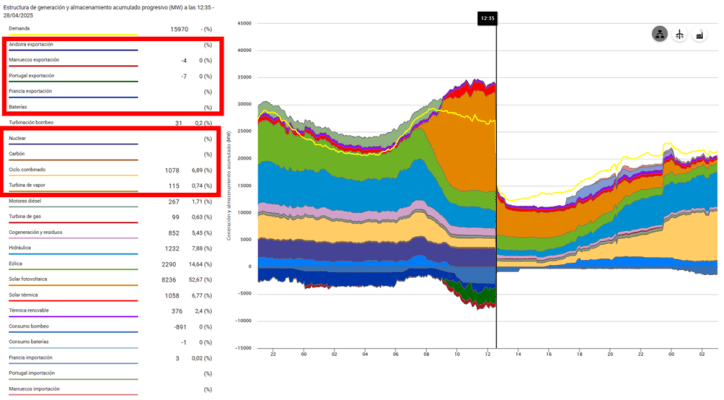
The rule of thumb is that the larger the power plant system, the more stable the grid frequency.
During these series of events, inertial energy can be provided or stored through the spinning rotors in synchronous generators or condensers. Inverter Based Resources (IBR) can also provide artificial inertia by quickly injecting or absorbing power to help regulate the grid. IBRs, such as solar PV, wind turbines, and battery storage, lack rotating masses and therefore do not inherently provide inertia to slow frequency changes. However, they can provide active power quickly enough using stored energy to stabilize the grid. Most power converters connected to the grid are grid-following (GFL) converters based on phase-locked loop synchronization, meaning they provide fixed active power during these events unless explicitly programmed otherwise, and they lack inherent voltage and frequency capabilities. The most suitable solution is grid-forming (GFM) inverters, which emulate inertia using control algorithms like virtual synchronous generator control and adjust power to mimic the inertia of rotational masses. Spain has high share of renewables- above the global average- and notably, the share of renewables share remain high even after the faults, while large power plants were tripped. This unfortunate and unforeseen event offered a chance to investigate the cause and draw important lessons.
Hopefully, further details will be shared later regarding the causes of these events and the resulting historic blackouts. Grid resilience and inertia are complex and important topics, and valuable lessons should be learned to prevent similar unfortunate incidents in the future.




 Sahas Bikram Shah